
Soft ears, bright eyes, and a tiny heartbeat make the bunny a tender symbol of innocence, luck, cleverness, and new beginnings. These names that mean bunny gather literal rabbit words, moon hare legends, folklore figures, nature choices, and beloved literary connections.
Some are established baby names. Others are rare word names, surnames, or myth inspired possibilities. Each table makes that distinction clear, helping you find a name that feels sweet without losing its cultural story.
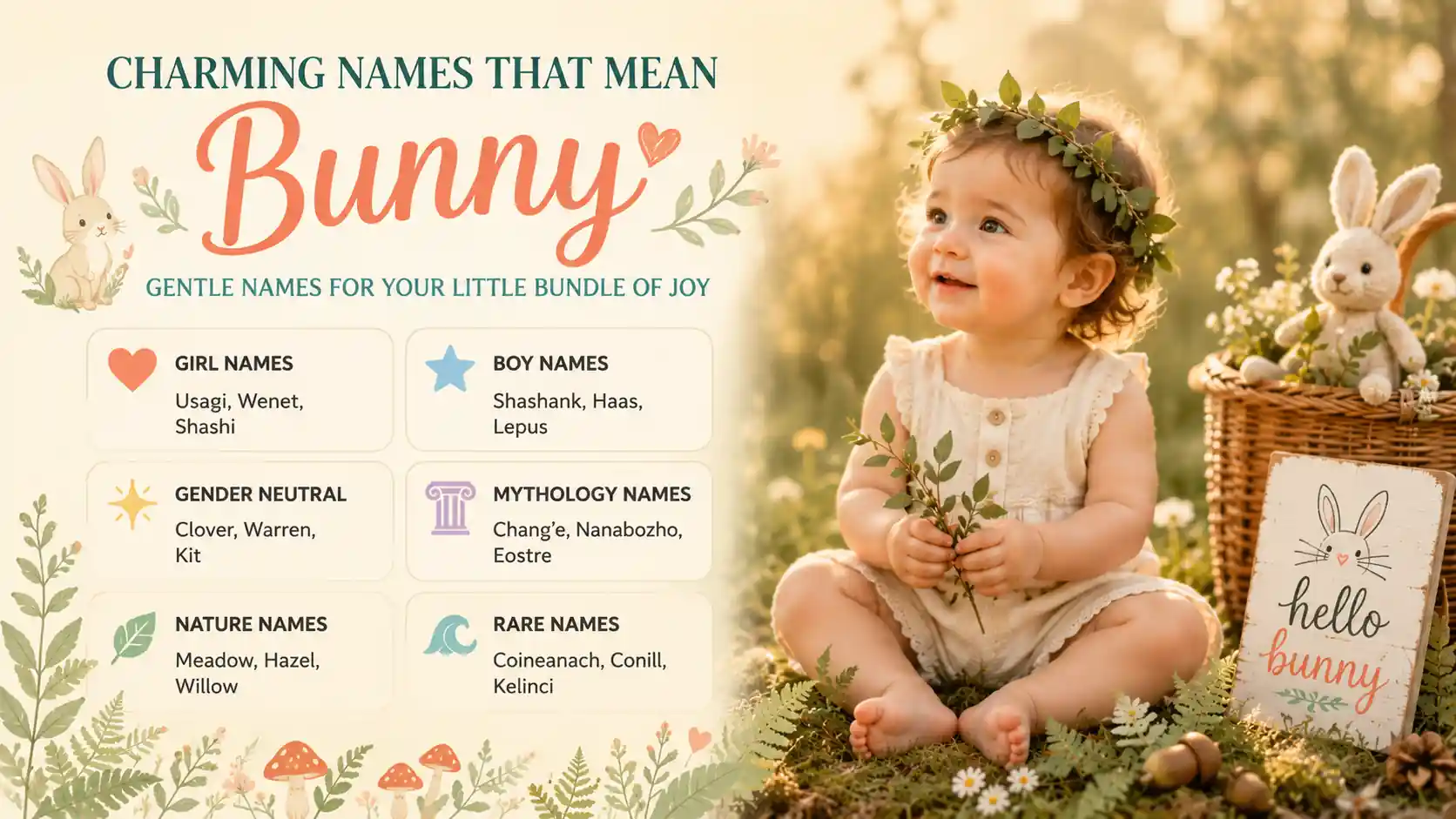
Sweet Girl Names That Mean Bunny & Gentle Hare
| Name | Origin | Meaning |
|---|---|---|
| Bunny | English | Affectionate word for a rabbit |
| Usagi | Japanese | Rabbit |
| Coelha | Portuguese | Feminine form connected with rabbit |
| Conejita | Spanish | Little female rabbit |
| Lapine | French | Feminine word related to rabbit |
| Wenet | Ancient Egyptian | Hare goddess |
| Unut | Ancient Egyptian | Alternate form of Wenet |
| Melangell | Welsh | Saint traditionally linked with hares |
| Harriette | French, English | Sounds playfully close to hare |
| Arneb | Arabic | Hare, also a star name |
| Shashi | Sanskrit | Moon, literally hare marked |
| Shashini | Sanskrit | The moon, bearer of the hare image |
| Sasikala | Sanskrit | A crescent or part of the hare marked moon |
| Tuzi | Chinese | Rabbit |
| Tù Nhi | Vietnamese | Little rabbit |
| Miffy | Dutch literary | Famous little white rabbit character |
Lively Boy Names with Rabbit Spirit
| Name | Origin | Meaning |
|---|---|---|
| Shashank | Sanskrit | Hare marked moon |
| Shashanka | Sanskrit | The moon with a hare upon it |
| Sasin | Sanskrit | Moon, possessor of the hare mark |
| Hase | German | Hare or rabbit |
| Haas | German, Dutch | Hare |
| Haso | Old German | Hare |
| Coniglio | Italian | Rabbit |
| Coelho | Portuguese | Rabbit |
| Conejo | Spanish | Rabbit |
| Lepus | Latin | Hare |
| Leveret | French, English | Young hare |
| Aranb | Arabic | Rabbit |
| Kalulu | East African folklore | Clever hare trickster |
| Oswald | English literary | Linked with Oswald the Lucky Rabbit |
| Benjamin | Hebrew, literary | Beatrix Potter’s Benjamin Bunny |
| Peter | Greek, literary | Peter Rabbit association |
Gender Neutral Bunny Names with Soft Nature Meanings
| Name | Origin | Meaning |
|---|---|---|
| Kit | English | A young rabbit |
| Coney | English | Rabbit, from an older English word |
| Hare | English | Swift long eared animal |
| Clover | English nature name | Favorite leafy food associated with rabbits |
| Thistle | English nature name | Wild plant found in rabbit habitats |
| Meadow | English | Open grassland where rabbits forage |
| Burrow | English | A rabbit’s underground home |
| Warren | English, Norman French | Enclosed rabbit habitat |
| Snow | English | Inspired by the snowshoe hare |
| Cotton | English | Suggests a rabbit’s fluffy tail |
| Flopsy | English literary | One of Peter Rabbit’s sisters |
| Pippin | English | Playful choice with a quick, lively sound |
| Juniper | Latin nature name | Evergreen shrub offering woodland shelter |
| Bramble | English nature name | Thorny wild growth sheltering rabbits |
| Willow | English nature name | Graceful tree associated with gentle landscapes |
| Velvet | English | Inspired by The Velveteen Rabbit |
Moonlit Names That Mean Bunny in Asian Tradition
| Name | Origin | Meaning |
|---|---|---|
| Yutu | Chinese | Jade Rabbit |
| Yuetu | Chinese | Moon Rabbit |
| Jinwu | Chinese | Golden hare, a poetic image of the moon |
| Yue | Chinese | Moon |
| Yu | Chinese | Jade |
| Tsuki | Japanese | Moon |
| Mochi | Japanese | Rice cake traditionally linked with the moon rabbit |
| Gekkō | Japanese | Moonlight |
| Tsukiko | Japanese | Moon child |
| Tsukimi | Japanese | Moon viewing |
| Dal | Korean | Moon |
| Tokki | Korean | Rabbit |
| Daltokki | Korean | Moon rabbit |
| Ngọc Thỏ | Vietnamese | Jade Rabbit |
| Hằng Nga | Vietnamese | Vietnamese name for the moon goddess Chang’e |
| Chandra | Sanskrit | Moon, connected with the hare shaped lunar markings |
Mythology & Folklore Names Touched by the Hare
| Name | Origin | Meaning |
|---|---|---|
| Chang’e | Chinese mythology | Moon goddess accompanied by the Jade Rabbit |
| Tu’er Ye | Chinese folklore | Rabbit deity honored in Beijing tradition |
| Nanabozho | Anishinaabe tradition | Transformative culture hero sometimes called Great Rabbit |
| Manabozho | Algonquian tradition | Variant name for the Great Hare culture hero |
| Michabo | Algonquian tradition | Great Hare figure in older recorded traditions |
| Nanabush | Ojibwe tradition | Trickster and culture hero linked with rabbit imagery |
| Mahtigwess | Indigenous North American folklore | Rabbit figure appearing in traditional narratives |
| Compère Lapin | Caribbean Creole folklore | Clever Brother Rabbit trickster |
| Brer Rabbit | African American folklore | Resourceful rabbit who survives through wit |
| Aunt Nancy | Gullah folklore | Trickster figure appearing beside Brer Rabbit traditions |
| Eostre | Germanic tradition | Spring goddess popularly associated with hares |
| Ostara | Modern Pagan usage | Spring name linked with hare symbolism |
| Aphrodite | Greek mythology | Goddess whose sacred animals included the hare |
| Artemis | Greek mythology | Wilderness goddess associated with wild animals |
| Freyja | Old Norse mythology | Goddess sometimes connected with hare folklore |
| Holda | Germanic folklore | Winter figure associated in later folklore with hares |
Rare Rabbit Names from World Languages
| Name | Origin | Meaning |
|---|---|---|
| Lapin | French | Rabbit |
| Lièvre | French | Hare |
| Lebre | Portuguese | Hare |
| Liebre | Spanish | Hare |
| Lepre | Italian | Hare |
| Conill | Catalan | Rabbit |
| Untxi | Basque | Rabbit |
| Coineanach | Scottish Gaelic | Rabbit |
| Coinín | Irish | Rabbit |
| Kelinci | Indonesian | Rabbit |
| Arnab | Bengali | Rabbit |
| Khargosh | Hindi, Urdu | Rabbit |
| خرگوش Khargush | Persian | Rabbit |
| Krolik | Polish | Rabbit |
| Zając | Polish | Hare |
| Nyúl | Hungarian | Rabbit or hare |
Literary Bunny Names with Familiar Warmth
| Name | Origin | Meaning |
|---|---|---|
| Beatrix | Latin, literary | Honors Peter Rabbit author Beatrix Potter |
| Potter | English surname | Tribute to Beatrix Potter |
| Cottontail | English literary | Peter Rabbit’s sister |
| Mopsy | English literary | One of Peter Rabbit’s sisters |
| Jemima | Hebrew, literary | Beatrix Potter’s Jemima Puddle Duck |
| Nutkin | English literary | Squirrel Nutkin from Potter’s woodland world |
| Cecily | Latin, literary | From Potter’s Cecily Parsley’s Nursery Rhymes |
| Velveteen | English literary | The toy rabbit who becomes real through love |
| Margery | Greek, literary | Honors Velveteen Rabbit author Margery Williams |
| Bunnicula | American literary | Vampire rabbit from the humorous children’s series |
| Edward | English literary | Rabbit hero of The Miraculous Journey of Edward Tulane |
| Tulane | English literary | Edward Tulane’s distinctive surname |
| Babbitty | British literary | Rabbit figure in The Tales of Beedle the Bard |
| Judy | Hebrew, popular culture | Judy Hopps from Zootopia |
| Lola | Spanish, popular culture | Lola Bunny from Looney Tunes |
| Roger | Germanic, popular culture | Roger Rabbit association |
Woodland & Spring Names Inspired by Rabbit Symbolism
| Name | Origin | Meaning |
|---|---|---|
| Dawn | English | First light, echoing rabbits active near sunrise |
| April | Latin | Spring month associated with new life |
| Flora | Latin | Flower and Roman goddess of blossoms |
| Blossom | English | A flower opening in spring |
| Fern | English nature name | Woodland plant offering low cover |
| Moss | English nature name | Soft green woodland growth |
| Aspen | English nature name | Slender woodland tree |
| Birch | English nature name | Pale barked forest tree |
| Hazel | English nature name | Tree and warm brown color |
| Sorrel | French nature name | Reddish brown shade seen in hare coats |
| Briar | English nature name | Thorny plant offering wildlife shelter |
| Fawn | English | Young deer and a soft brown color |
| Sage | Latin, English | Wise person and aromatic herb |
| Luna | Latin | Moon |
| Selene | Greek | Moon goddess |
| Jade | Spanish, English | Green gemstone recalling the Jade Rabbit |
A literal rabbit translation can feel daring, especially when it comes from a language your family does not speak. Check pronunciation, cultural usage, and whether the word is commonly used as a personal name before placing it on a birth certificate.
The gentlest choices often carry the symbolism without naming the animal directly. Luna, Clover, Warren, Jade, Hazel, and Shashi preserve the moonlit or woodland feeling of names that mean bunny while remaining easy to wear through adulthood.
Rabbit symbolism changes beautifully across cultures. Sanskrit lunar names remember the hare shaped markings on the moon, while Chinese tradition places the Jade Rabbit beside Chang’e, preparing sacred medicine in his mortar.
Japanese and Korean stories picture a moon rabbit making rice cakes. In several Indigenous North American traditions, Great Hare figures appear as powerful creators, teachers, or tricksters rather than simply cute woodland animals.
For a baby who has brought fresh hope into your home, these names that mean bunny can represent quick intelligence, tenderness, fertility, survival, and joyful renewal. The right choice may be sweet and obvious, or quietly hidden inside an ancient moon story.
Are names that mean bunny usually traditional baby names?
Some are established names, while others are language words, surnames, literary references, or modern nature choices.
What is the most wearable Japanese rabbit name?
Usagi literally means rabbit, though it is far more familiar as a character name than an everyday Japanese given name.
Which bunny name has the strongest connection to the moon?
Shashank means hare marked moon, while Yutu names the Jade Rabbit of Chinese lunar mythology.
Can I use Bunny as a full legal name?
Yes, though many parents prefer Bunny as a nickname for Berenice, Bernadette, or another formal name.
Which rabbit inspired names feel subtle rather than childish?
Luna, Jade, Clover, Warren, Hazel, Shashi, Selene, and Arneb carry the imagery in a more understated way.