
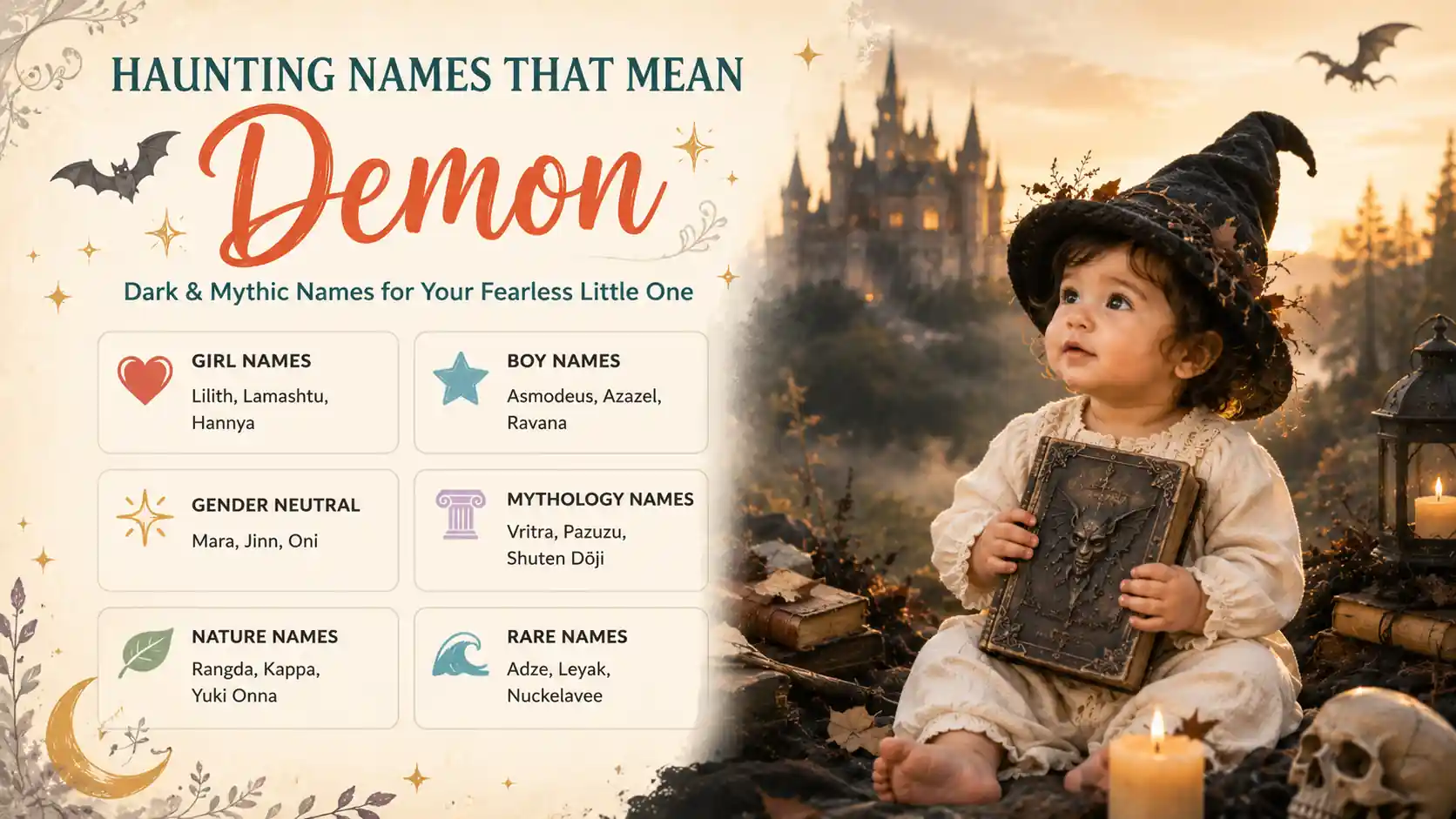
Some names arrive wrapped in sunlight. Others carry midnight, mystery, rebellion & ancient power. Names that mean demon draw from old languages, sacred stories, regional folklore & legendary beings once blamed for storms, temptation, illness or chaos.
Many choices below are not traditional baby names. Some are mythic titles, spirit classes or supernatural figures. Still, their dramatic sounds & layered histories may inspire your baby’s name, a middle name or a memorable fictional character.
Female Demon Names with Dark Feminine Power
| Name | Origin | Meaning |
|---|---|---|
| Lilith | Akkadian, Jewish tradition | Night spirit or female demon |
| Lamashtu | Mesopotamian | Lion headed demoness associated with disease |
| Lamia | Greek | Child haunting female monster |
| Abyzou | Byzantine folklore | Female demon blamed for infant illness |
| Gello | Greek folklore | Restless female spirit |
| Empusa | Greek | Shape shifting female apparition |
| Hannya | Japanese | Jealous woman transformed into a demon |
| Onibaba | Japanese folklore | Demon hag or ogress |
| Rangda | Balinese | Powerful demon queen |
| Pontianak | Malay folklore | Vengeful female spirit |
| Naamah | Jewish folklore | Seductive night demon |
| Agrat | Jewish demonology | Female spirit of the night |
| Eisheth | Jewish demonology | Woman of destruction |
| Al | Armenian, Persian folklore | Childbirth threatening female spirit |
| Churel | South Asian folklore | Vengeful female ghost |
| Karina | Arabic folklore | Spirit double or supernatural companion |
These names that mean demon often carry themes of rage, independence & transformation. Lilith feels especially wearable, while Hannya, Rangda & Lamashtu make bolder choices.
Several figures were created to explain dangers surrounding childbirth or the night. Their stories can feel frightening, but they also preserve the fears, warnings & protective rituals of earlier communities.
Male Names That Mean Demon, Devil or Adversary
| Name | Origin | Meaning |
|---|---|---|
| Asmodeus | Iranian, Jewish tradition | King of demons linked with wrath or desire |
| Azazel | Hebrew tradition | Wilderness figure associated with the scapegoat |
| Belial | Hebrew | Worthlessness, later a demonic figure |
| Beelzebub | Northwest Semitic | Lord of flies |
| Ahriman | Zoroastrian tradition | Destructive or hostile spirit |
| Pazuzu | Mesopotamian | Wind demon of the southwest |
| Ravana | Sanskrit epic tradition | Roaring demon king of Lanka |
| Mahishasura | Sanskrit | Buffalo demon |
| Bhasmasura | Sanskrit | Ash demon |
| Andhaka | Sanskrit | Blind one, an asura antagonist |
| Samael | Jewish tradition | Venom of God, linked with severity |
| Iblis | Islamic tradition | The being who refused to bow to Adam |
| Lucifer | Latin, Christian tradition | Light bearer, later linked with the Devil |
| Abaddon | Hebrew | Destruction or place of ruin |
| Apollyon | Greek | Destroyer |
| Mephistopheles | German literary tradition | Demonic tempter in the Faust legend |
A few of these names sound surprisingly polished. Samael resembles Samuel, while Azazel has the rhythm of a modern fantasy name.
The meanings require care. Lucifer originally described the morning star, while Belial began as a Hebrew word connected with worthlessness before becoming a named supernatural adversary.
Gender Neutral Names That Mean Demon or Restless Spirit
| Name | Origin | Meaning |
|---|---|---|
| Mara | Sanskrit, Buddhist tradition | Tempter who obstructs awakening |
| Daeva | Avestan | Hostile supernatural being |
| Asura | Sanskrit | Powerful being opposed to the devas |
| Rakshasa | Sanskrit | Supernatural being, often a malevolent shape shifter |
| Jinn | Arabic | Unseen spirit formed from smokeless fire |
| Ifrit | Arabic folklore | Powerful rebellious spirit |
| Ghoul | Arabic | Graveyard dwelling monster |
| Oni | Japanese | Ogre, demon or fearsome spirit |
| Akuma | Japanese | Evil spirit or devil |
| Yōkai | Japanese | Strange supernatural apparition |
| Dybbuk | Yiddish, Jewish folklore | Clinging possessing spirit |
| Shedim | Hebrew | Spirits or demons |
| Lilin | Jewish folklore | Night spirits associated with Lilith |
| Preta | Sanskrit, Buddhist tradition | Hungry ghost |
| Bhuta | Sanskrit | Ghost, spirit or supernatural being |
| Pishacha | Sanskrit | Flesh eating spirit |
Not every culture divides spirits neatly into good & evil. Jinn may help, harm or simply remain unseen, while yōkai range from playful tricksters to terrifying threats.
For parents exploring names that mean demon, Mara may be the easiest crossover choice. It is established in several languages even though its Buddhist association carries a darker edge.
Mesopotamian Demon Names Carved from Ancient Night
| Name | Origin | Meaning |
|---|---|---|
| Lilu | Akkadian | Male night or wind spirit |
| Lilitu | Akkadian | Female wind spirit |
| Ardat Lili | Mesopotamian | Maiden spirit of the night |
| Labasu | Akkadian | Disease bringing demon |
| Ahhazu | Akkadian | Seizer or possessing demon |
| Gallu | Sumerian | Underworld demon |
| Utukku | Akkadian | Supernatural spirit, sometimes hostile |
| Alu | Mesopotamian | Faceless night demon |
| Rabisu | Akkadian | Lurker or spirit lying in wait |
| Asakku | Sumerian, Akkadian | Disease demon |
| Sebettu | Akkadian | The Seven, a group of destructive spirits |
| Dimme | Sumerian | Name used for Lamashtu |
| Hanbi | Mesopotamian | Father of Pazuzu |
| Ugallu | Mesopotamian | Great weather beast or protective demon |
| Kusarikku | Mesopotamian | Bison man spirit |
| Humbaba | Sumerian epic | Monstrous guardian of the Cedar Forest |
Clay tablets, cylinder seals & protective amulets kept many of these names alive. The beings were feared, yet images of one dangerous spirit could sometimes be used to repel another.
That tension makes Mesopotamian lore unusually compelling. Pazuzu, for example, was frightening in appearance but could be invoked against the child threatening Lamashtu.
Asuras & Rakshasas from Hindu and Buddhist Epics
| Name | Origin | Meaning |
|---|---|---|
| Kumbhakarna | Sanskrit | Pot eared rakshasa giant |
| Shurpanakha | Sanskrit | Woman with nails like winnowing baskets |
| Tataka | Sanskrit epic tradition | Powerful forest rakshasi |
| Putana | Sanskrit | Child threatening demoness defeated by Krishna |
| Bakasura | Sanskrit | Crane demon |
| Aghasura | Sanskrit | Serpent demon |
| Vritra | Sanskrit | Enveloper or blocker |
| Hiranyakashipu | Sanskrit | Clothed in gold |
| Hiranyaksha | Sanskrit | Golden eyed |
| Tarakasura | Sanskrit | Asura defeated by Kartikeya |
| Narakasura | Sanskrit | Demon associated with Naraka |
| Raktabija | Sanskrit | Blood seed |
| Dhumralochana | Sanskrit | Smoke eyed |
| Chanda | Sanskrit | Fierce or violent |
| Munda | Sanskrit | Shaven headed |
| Trinavarta | Sanskrit | Whirlwind demon |
These figures are more complex than a simple list of villains. Asuras can be ambitious rivals of the gods, while rakshasas may appear as warriors, rulers, shape shifters or protectors.
Vritra carries one of the most striking symbolic meanings. As the enveloper who holds back the waters, the figure represents obstruction before release.
Oni, YōKai & Demon Names from Japanese Folklore
| Name | Origin | Meaning |
|---|---|---|
| Shuten Dōji | Japanese | Sake drinking boy, a legendary oni leader |
| Ibaraki Dōji | Japanese | Powerful oni of Mount Ōe legends |
| Ōtakemaru | Japanese | Great demon associated with Suzuka Mountain |
| Tamamo no Mae | Japanese | Fox spirit disguised as a court woman |
| Yuki Onna | Japanese | Snow woman |
| Kuchisake Onna | Japanese | Slit mouthed woman |
| Jorōgumo | Japanese | Spider woman |
| Tengu | Japanese | Mountain spirit with birdlike traits |
| Nurarihyon | Japanese | Mysterious yōkai who enters busy homes |
| Gashadokuro | Japanese | Giant starving skeleton |
| Amanojaku | Japanese | Contrary minded demon or trickster |
| Namahage | Japanese | Masked ogre figure who warns children |
| Ushi Oni | Japanese | Ox demon |
| Nure Onna | Japanese | Wet woman with serpentine features |
| Kappa | Japanese | River dwelling yōkai |
| Futakuchi Onna | Japanese | Two mouthed woman |
Japanese folklore offers some of the most vivid names that mean demon or supernatural being. You can almost see the snowy road behind Yuki Onna or hear Shuten Dōji’s feast inside his mountain stronghold.
Not every creature is purely wicked. Kappa can be dangerous, comic or strangely honorable, while Namahage plays a ritual role that encourages good behavior & community discipline.
Greek, Roman & European Names with Infernal Legends
| Name | Origin | Meaning |
|---|---|---|
| Mormo | Greek | Frightening female spirit |
| Mormolykeia | Greek | She wolf bogey spirit |
| Keres | Greek | Spirits of violent death |
| Alastor | Greek | Avenger or punishing spirit |
| Eurynomos | Greek | Underworld spirit associated with decay |
| Melinoë | Greek | Underworld nymph linked with ghosts |
| Alecto | Greek | Unceasing anger |
| Megaera | Greek | The jealous one |
| Tisiphone | Greek | Avenger of murder |
| Cacus | Roman | Fire breathing cave monster |
| Orcus | Roman, Etruscan | Underworld punisher |
| Incubus | Latin folklore | Male night demon |
| Succubus | Medieval Latin | Female night demon |
| Krampus | Alpine folklore | Horned winter punisher |
| Bies | Slavic folklore | Evil spirit or demon |
| Zmeu | Romanian folklore | Supernatural dragonlike adversary |
Alecto, Megaera & Tisiphone belong to the Erinyes, relentless figures who punish grave wrongdoing. Their names carry anger, jealousy & vengeance rather than literal translations of demon.
Melinoë feels softer on the ear. Her ghostly underworld story gives the name an eerie silver glow without the harsh sound of many infernal choices.
Rare Demon Names from Global Folklore
| Name | Origin | Meaning |
|---|---|---|
| Adze | Ewe folklore | Vampiric spirit that may appear as a firefly |
| Asanbosam | Akan folklore | Tree dwelling iron toothed creature |
| Obayifo | Ashanti folklore | Witchlike vampiric being |
| Tikoloshe | Southern African folklore | Mischievous or dangerous water spirit |
| Aisha Qandisha | Moroccan folklore | Enchanting female spirit |
| Qarina | Arabic folklore | Supernatural double or companion |
| Si’lat | Arabian folklore | Shape shifting jinn |
| Nasnas | Arabic folklore | Half formed monstrous being |
| Leyak | Balinese folklore | Shape shifting practitioner or spirit |
| Penanggalan | Malay folklore | Flying head with trailing organs |
| Krasue | Southeast Asian folklore | Nocturnal floating female head |
| Manananggal | Filipino folklore | Winged being that separates its upper body |
| Nuckelavee | Orcadian folklore | Skinless sea demon |
| Popobawa | Zanzibar folklore | Bat winged attacking spirit |
| Impundulu | Southern African folklore | Lightning bird associated with witchcraft |
| Nalusa Chito | Choctaw tradition | Great black being or soul devourer |
Rare names that mean demon often preserve the landscape around them. Some rise from rivers, hide in trees, ride storms or appear on lonely roads after dark.
Their traditions deserve respectful handling. A supernatural figure may still belong to a living belief system, so learning the cultural context matters before borrowing its name.
Questions Parents Ask About Demon Inspired Baby Names
Do any names literally mean demon?
Akuma, Oni, Bies & related folklore terms can directly translate as demon, devil or evil spirit.
Is Lilith really a demon name?
Lilith comes from ancient Near Eastern night spirit traditions & later Jewish folklore.
Are jinn always considered evil?
No, Islamic tradition describes jinn as morally responsible beings who may be good, harmful or neutral.
Which dark name feels most wearable for a baby?
Mara, Lilith, Samael, Alastor & Melinoë have familiar sounds despite their shadowed associations.
Should I use a sacred demon name without knowing its culture?
Learn its pronunciation, religious setting & living cultural significance before making it your child’s name.